Where to start
Identify what evidence the user needs and which decisions must be reviewed.
AI solutions
Build a product in which retrieval, drafting or classification is part of the customer’s everyday task.

Identify what evidence the user needs and which decisions must be reviewed.
Prototype a narrow assistant, ground the output in approved sources and test uncertain requests.
A working pilot, evaluation examples, access rules and a human handoff.
Applied AI
Where did that answer come from? Which invoice line needs a second look? Try three examples of how AI can help a team check its work.
A proposed workspace for answering customer enquiries from approved company information.
Explore the project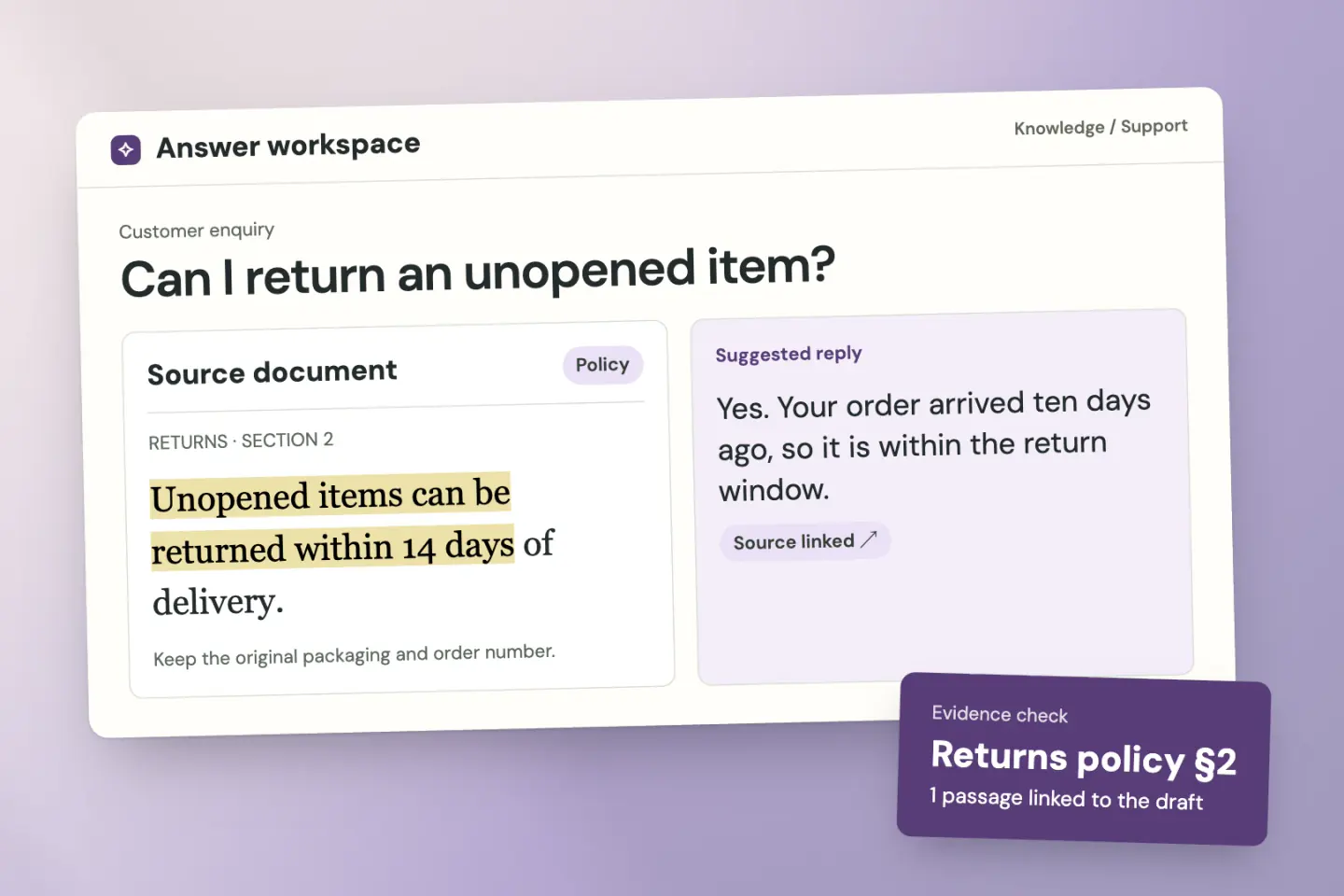
Bring anonymised examples, approved source material and a description of where an incorrect answer would matter most.
Agree what the assistant can access, which actions need approval and the evidence needed before rollout.
Architecture
Use deterministic rules when the decision depends on an exact amount, permission or policy threshold.
Bring a model into tasks such as drafting, extracting or classifying. Keep the source record and the proposed result together for review.
Route uncertain cases and consequential changes to a named owner. Record what was accepted and why.

Scope a first release around a real customer task, then make onboarding, billing and support repeatable.

Coordinate multilingual content from the source brief through review and publication.

Help shoppers choose the right product and give retail teams a clearer view of orders and availability.
For a travel request, understanding a place name matters as much as understanding the question. Our tools cover language models, speech, document extraction and matching.
 Google Gemini
 Sarvam AI
 RapidFuzz
 pypdf
Map the business problem, the people it affects and the constraints. Agree on what a good outcome looks like.
A prioritised brief, dependencies and an agreed first release.Turn key journeys into a working prototype. Test the important decisions before writing production code.
A prototype, decision log and handoff notes for the core states.Build in small releases. Review working features together and check accessibility, reliability and performance.
Working increments, test evidence and a release candidate.Plan the rollout, monitor the product and use real feedback to decide what to improve next.
A rollout checklist, named owners and a review of the first signals.Yes. Bring a defined task, like redesigning a checkout or connecting two systems, or ask us to help scope a larger programme.
Tell us who the product serves, what needs to change, what you already have and when you want to launch. A rough budget helps us suggest an appropriate scope.
We can scope a specific workstream alongside your product, engineering or marketing team. We agree ownership, decision makers and handover before delivery begins.
Engagement models
Extend your team
Bring a designer or engineer into a team you already lead. You choose the backlog and the work they own.
Build a product together
Give a product a steady team across design, engineering and testing, with one shared roadmap.
Deliver a defined release
Start with a clear deliverable. Agree the scope, acceptance checks and milestones before development begins.
Contact Trvios
Tell us who it serves, what needs to change and which decision you want help making.
Contact details