
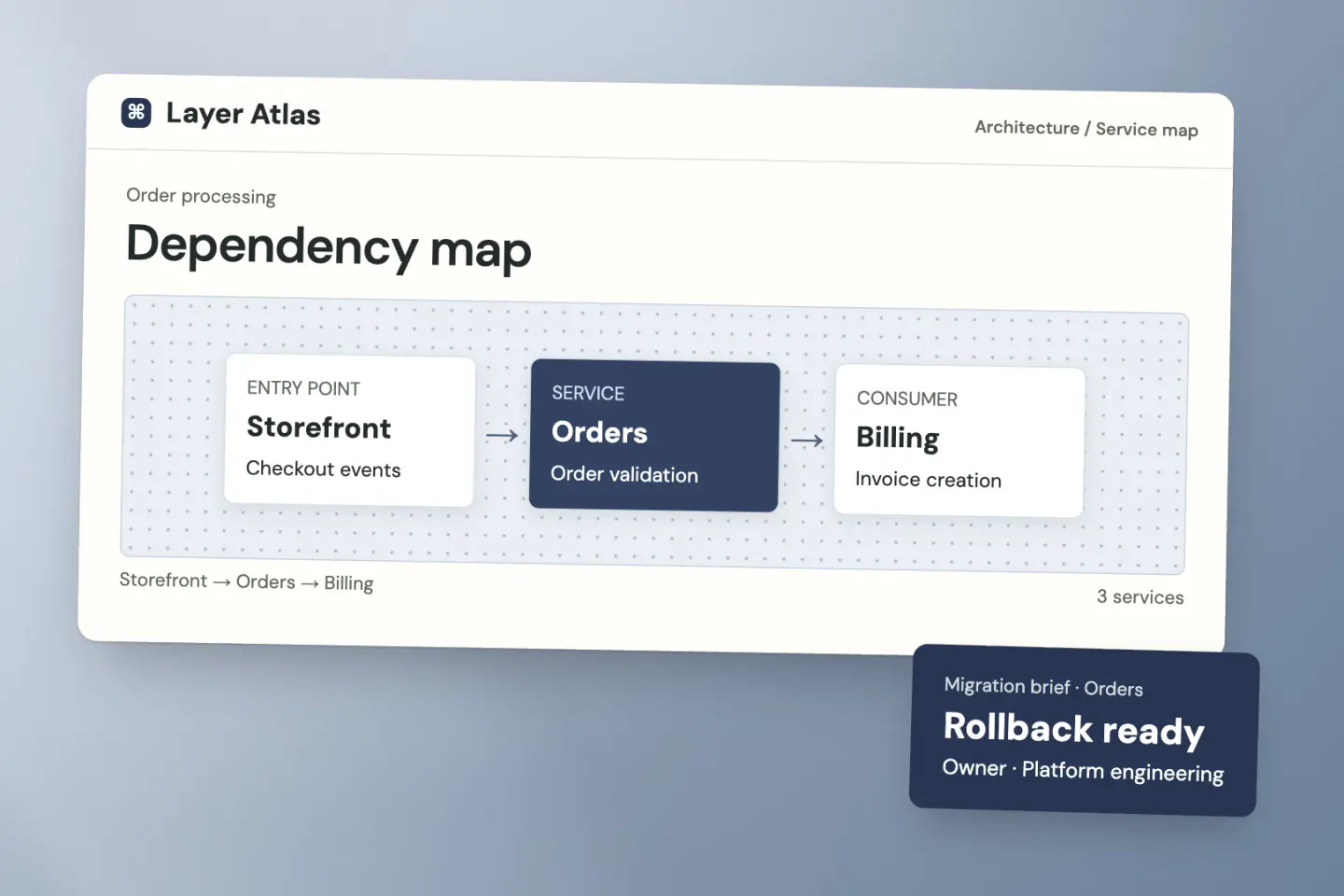
Which service can move first, and how would the team move it back?
A diagram may show which services connect, yet omit the person who can approve a change or the path back after a failed release.
Each dependency in the study carries an owner, a consumer and a release check. A migration brief collects the evidence for moving a single boundary.
- Designed for
- Platform and engineering leads
- Relevant service
- AI-led application modernisation
Design decisions
Dependency map
Trace a real order from storefront to billing. The map starts with this transaction so every dependency represents something that could break for a user.
Release ownership
Attach an owner to the boundary being changed. In the example, platform engineering owns the orders service and needs a check from its billing consumer.
Cutover and rollback brief
Agree on the release check and rollback path together. A cutover brief should tell the on-call engineer what to observe and when to restore the previous behaviour.
Follow an order across services
Follow an order from the storefront into billing. Identify which consumer must still receive the old event, and record a check that would catch a broken handoff.
- Entry point
- Storefront accepts the checkout
- Service owner
- Platform engineering validates the order
- Downstream check
- Billing receives the order event
- Release decision
- Revert if the event stops reaching billing
Modernising a live platform?
Choose a service you need to change and the downstream team that depends on it. We can map the dependency and define a first release with a clear recovery path.